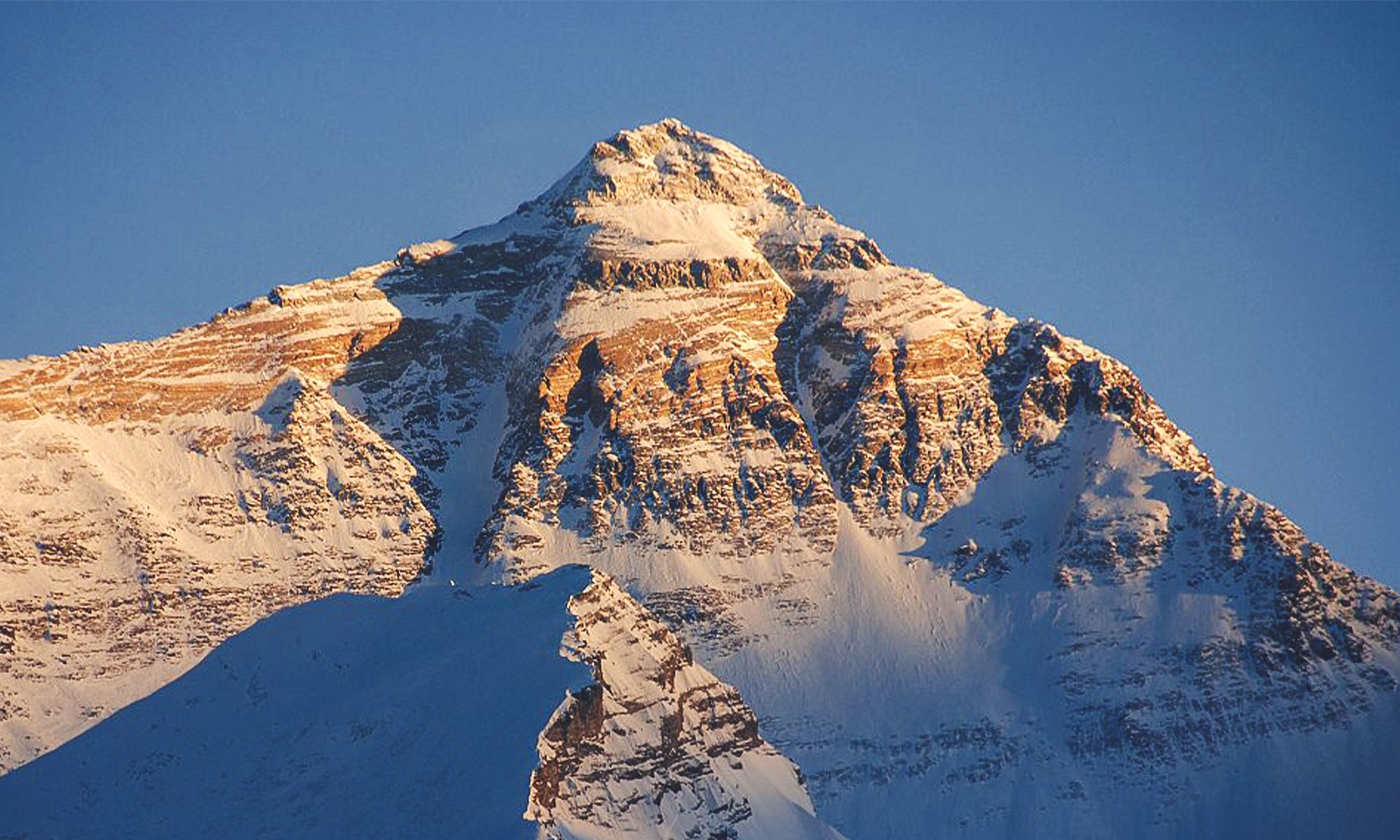
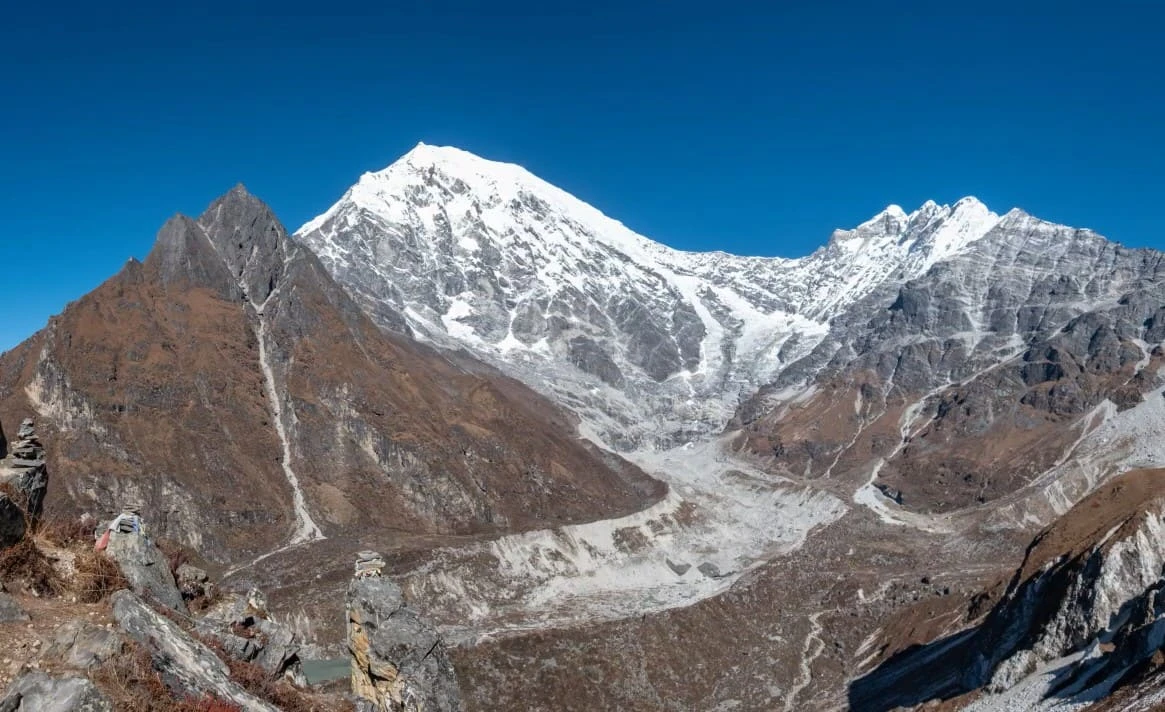
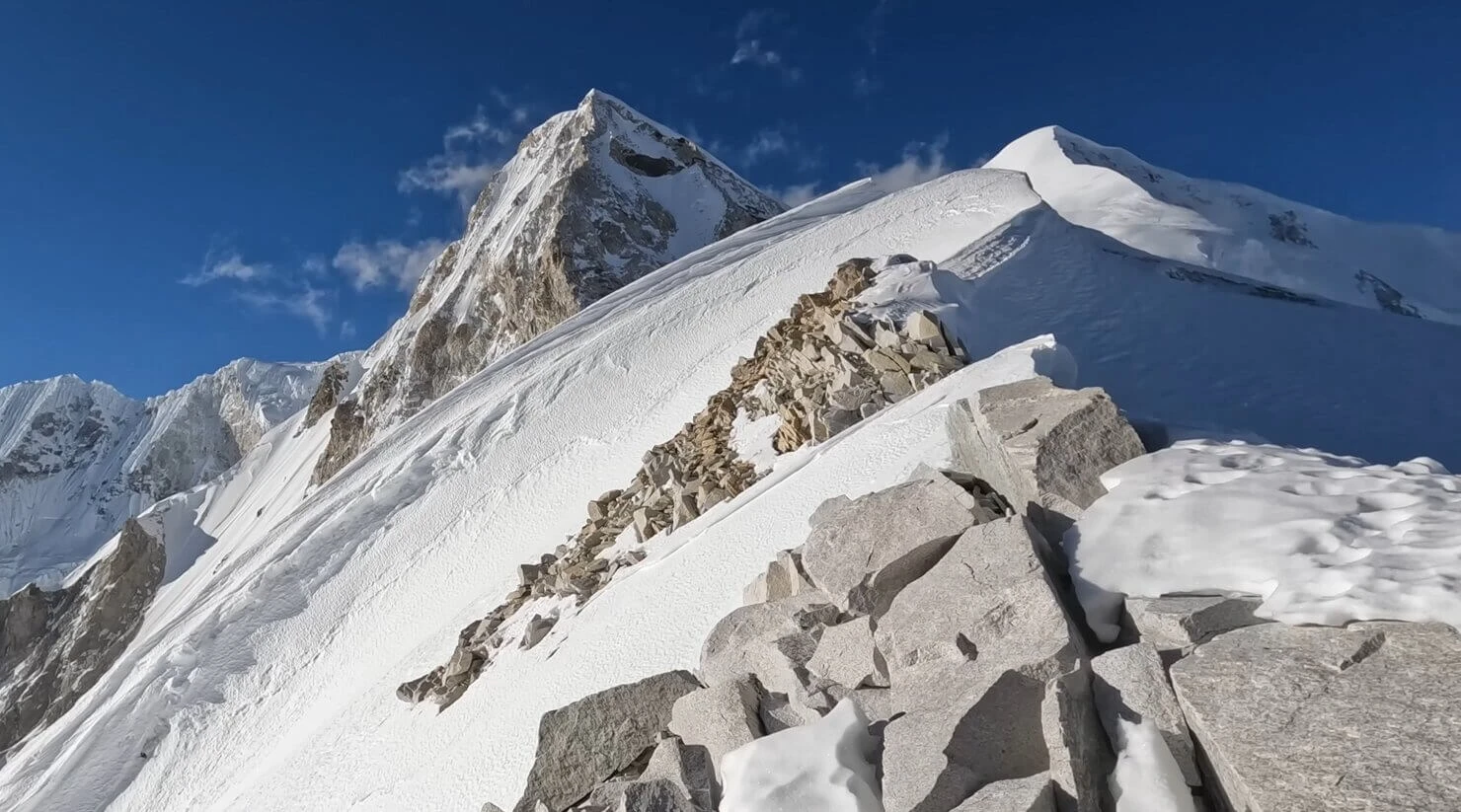
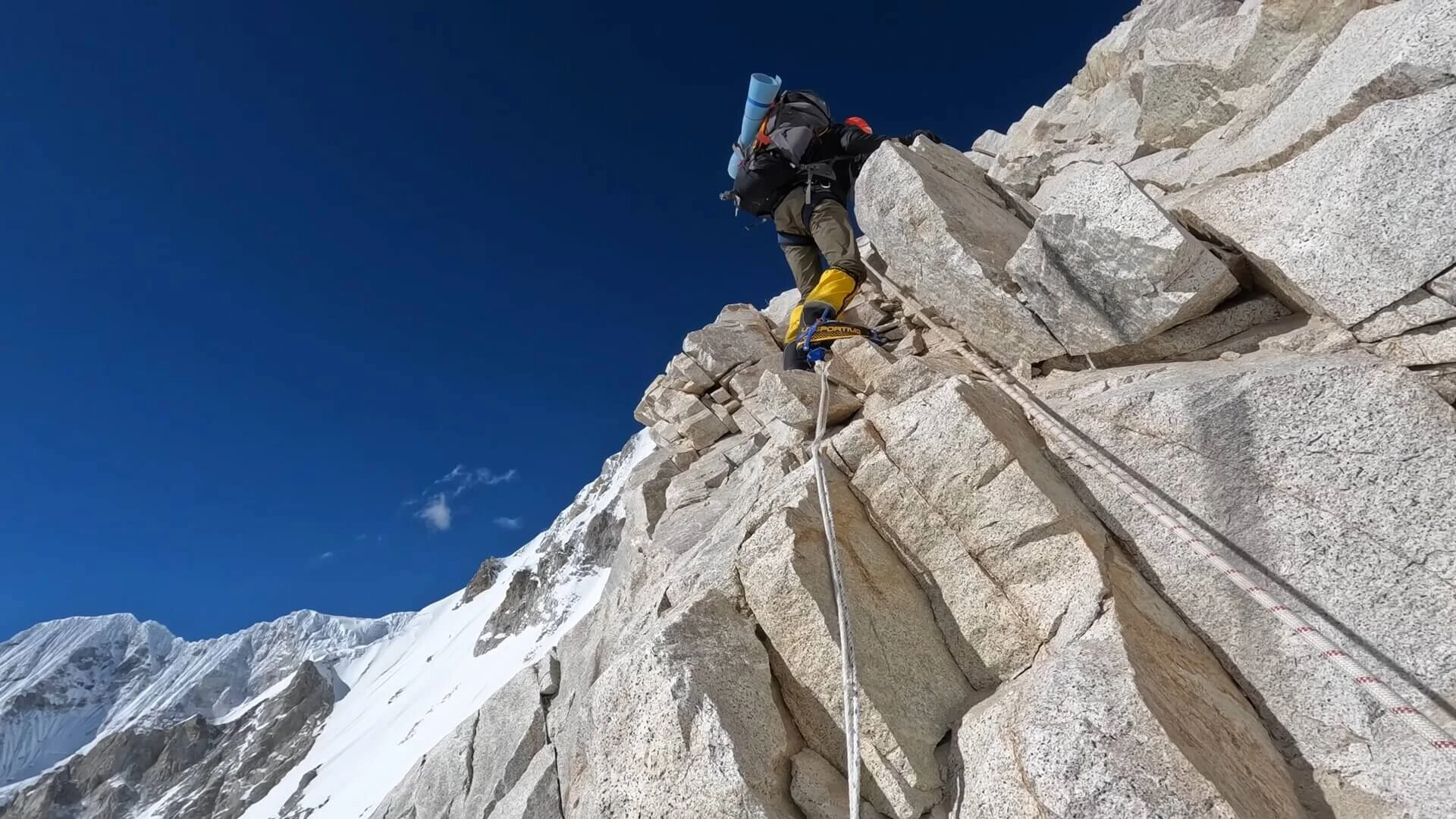
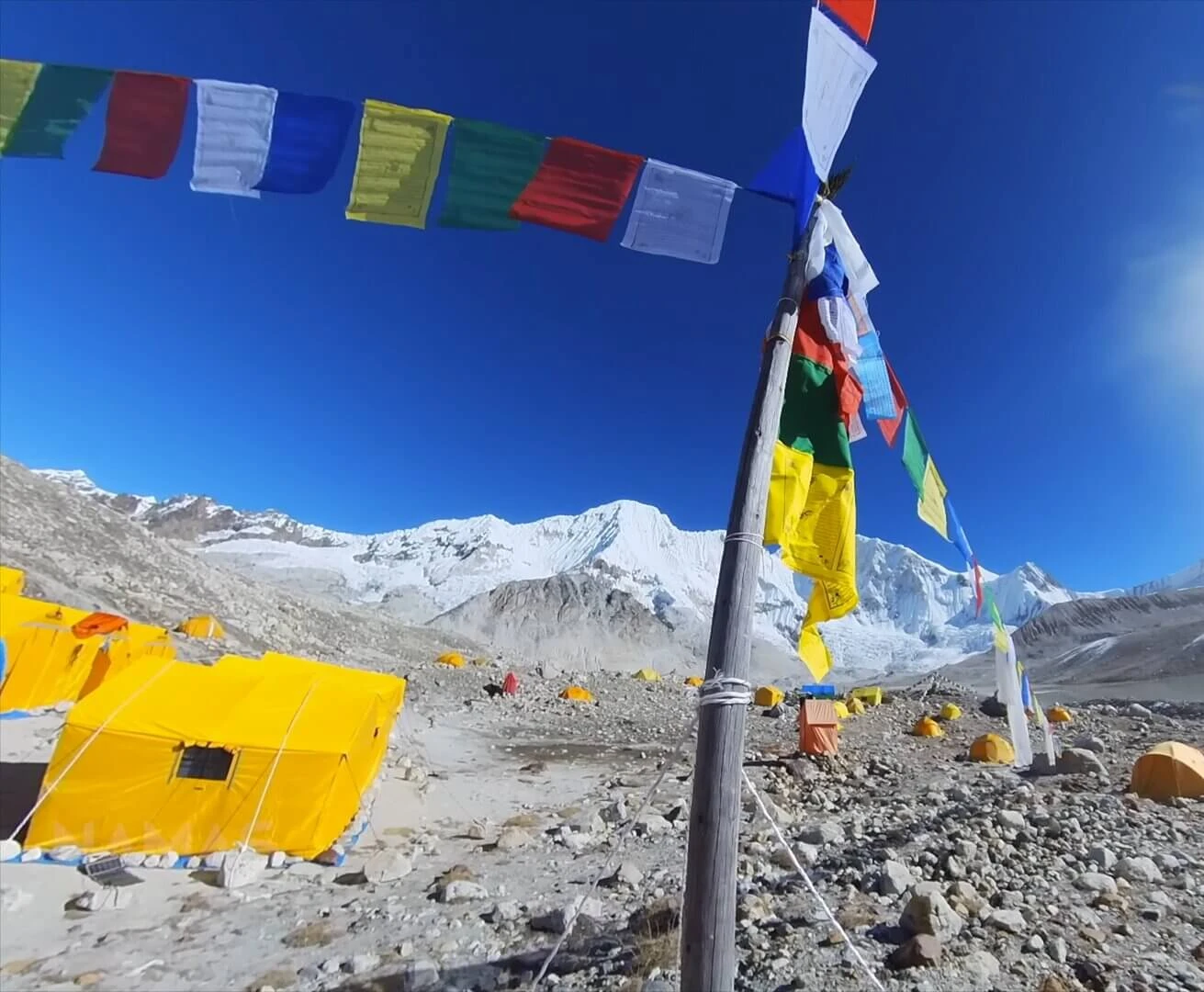
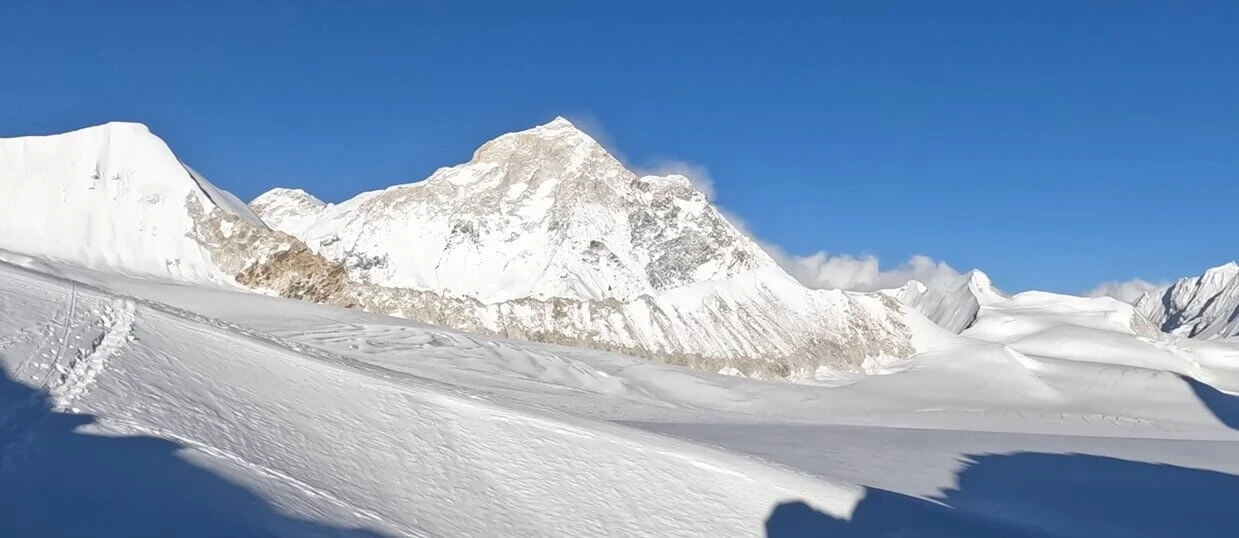
Mount Baruntse (7,129 m) in Nepal offers a thrilling blend of high-altitude climbing and trekking through glaciers, snow ridges, and vibrant Sherpa villages, preparing adventurers for future 8000-meter peaks. Its breathtaking views, challenging routes, and inspiring stories like Mera, the brave dog who summited make every step of the journey unforgettable.
Destination
Nepal
Duration
32
Destination
Nepal
Duration
32
Trip Difficulty
Strenuous
Accommodation
Tent
Meals
B, L, & D
Max. Elevation
7129
Group Size
2 to 15
Best Time
Sept - Nov & March - May
| Route | Difficulty | Best For | Avalanche Risk | Popularity |
|---|---|---|---|---|
| South-East Ridge | Moderate – Hard | First-time 7000m climbers | Low | Very High |
| West Ridge | Hard – Very Hard | Experienced mountaineers | Moderate | Low |
| South-West Face | Expert Only | Technical specialists | High | Rarely Used |
| Peak | Altitude | Difficulty | Permit Cost | Best Season | 8000m Prep Value | Action |
|---|---|---|---|---|---|---|
| Baruntse | 7,129m | Hard | $500 | Oct / May | ⭐ Excellent | 👉 View Details |
| Mera Peak | 6,476m | Moderate | $250 | Oct / May | Good | 👉 View Details |
| Island Peak | 6,189m | Moderate | $250 | Oct / May | Moderate | 👉 View Details |
| Ama Dablam | 6,812m | Hard | $400 | Oct / Nov | Good | 👉 View Details |
| Lobuche East | 6,119m | Moderate | $250 | Oct / May | Moderate | 👉 View Details |
Baruntse is more than just a climb it’s a defining step into the world of real Himalayan expeditions. With its perfect balance of technical challenge, altitude exposure, and expedition-style climbing, it prepares you for the ultimate goal of 8000m peaks. With Summit 8000’s expert Sherpa team, premium logistics, and carefully designed itinerary, you don’t just attempt the summit you build the experience, confidence, and strength to go higher. If you’re serious about your mountaineering journey, 2027 is your moment to take that leap.
Book Your Baruntse Expedition Now
| Year | Event | Route | Source |
|---|---|---|---|
| 1954 | First ascent Colin Todd & Geoff Harrow (NZ expedition led by Hillary) | South-East Ridge | Wikipedia / Himalayan Database |
| 1980 | First ascent of East Ridge Spanish expedition (Ortas, Escartín, López, Buhler) | East Ridge | Wikipedia / Himalayan Database |
| 1995 | First ascent of West Face Russian team (Pershin, Vinogradski, Habibulin, Zhilin, Ermachek) | West Face | AAC Journal / Wikipedia |
| 2010 | Becky Bellworthy (UK) becomes youngest woman to summit, age 18 | SE Ridge | Wikipedia |
| 2010 | Chhewang Nima (19× Everest summiteer) died after falling through a cornice | SE Ridge | Wikipedia |
| 2018 | "Mera," a stray dog, summited Baruntse after following a trekking team | SE Ridge | Wikipedia |
Baruntse has inspired countless climbers, but few stories are as unforgettable as Mera, the brave stray dog who conquered the 7,129-meter peak in 2018. Following a trekking team, facing freezing temperatures, steep trails, and high-altitude challenges, Mera reached the summit with courage and determination.
She’s not just a dog she’s a symbol of perseverance and the adventurous spirit that Baruntse instills in everyone who climbs it. Mera’s journey reminds us that with bravery, focus, and determination, no peak is too high to achieve.
This is also my favorite Baruntse story because it perfectly captures the essence of what makes this mountain so special: the challenge, the adventure, and the inspiration it gives to all who attempt it. Every climber stepping on Baruntse carries a little bit of Mera’s spirit with them. Read her full story and journey.
Let Mera inspire your own journey: Book your Baruntse Expedition today!
Namaste and welcome to Kathmandu valley the gateway to your dream destinations. One of our team mates from our company will be waiting for you at the airport with your banner name. Upon meeting you will have meet and greet session and we will drive to Thamel. Rest and relax for the day.
Today will be the day when your guide will meet you and he will help you to do buy or renting the packing lists required for the Baruntse expeditions. You will get many gears and equipment shops and from them our guide will find the best shop for you. After getting your packing lists done you will get the permits as well on the same day. After completing all these things if you are left with some time we would suggest you to visit the nearby Swayambhu Nath Stupa for the city view and hiking experience.
Early in the morning you will have a flight to Lukla. Yes, you heard it right the airport is not only gateway to the Everest region treks but it’s also the gateway to the Baruntse, Everest, Cho Oyu and surround peak climbing. You will have 35 minutes flights above the mountain and then reach Lukla. Upon reaching the place you will start your trek to the Chutanga village. It’s a peaceful campsite forests which is known for its majestic views of the surrounding peaks and then the beautiful Rhododendron forests.
Today will be the most demanding trek for you as you will be crossing the Zatrawa la pass at the altitude of the 4,610m (15,125ft) above sea level. The pass is known for its beautiful mountain passes and the gateway to the Hinku Valley which is in another Makalu region and it separate the Everest region with the Makalu.
Early morning trek to the Kothe a beautiful village entry to the Hinku valley. From the valley you will be crossing the dense rhododendron and bamboo forests, crossing streams and ridges. Upon reaching the Kothe you will see that it’s a small settle which is made seasonally for the climbers who wants to summit the Mera peak and the Baruntse peak.
You will stat your day from the walking to the Thangnak village which is a high-altitude village alongside the Hinku river. It is known for its alpine valley due to the high-altitude deserts and no sign of the forests. On the way you can experience the soothing sound of the Hinku river flowing in its potential along side the trail. Upon reaching your summit team will also do the health monitoring for your safety.
Start your day with the hearty breakfast in your accommodations. After the guide brief you will head towards the Khare village in the Makalu region. You will be ascending towards the Khare alongside the glacier moraines and specular mountain views. Witness the dramatic mountain views of the Mera peak, Kusum Kanguru, and the Charpate Himal.
As the Khare village is located at an altitude of the 5,054m its necessary for you to acclimate properly to adapt the high-altitude thin air. For the adaption of the thin air we will have a hike to the nearby short rides from where you can witness the dramatic landscapes. As it’s the rest day you will have a practice for the ice axe technique, crampons walking, fixed rope ascending and descending.
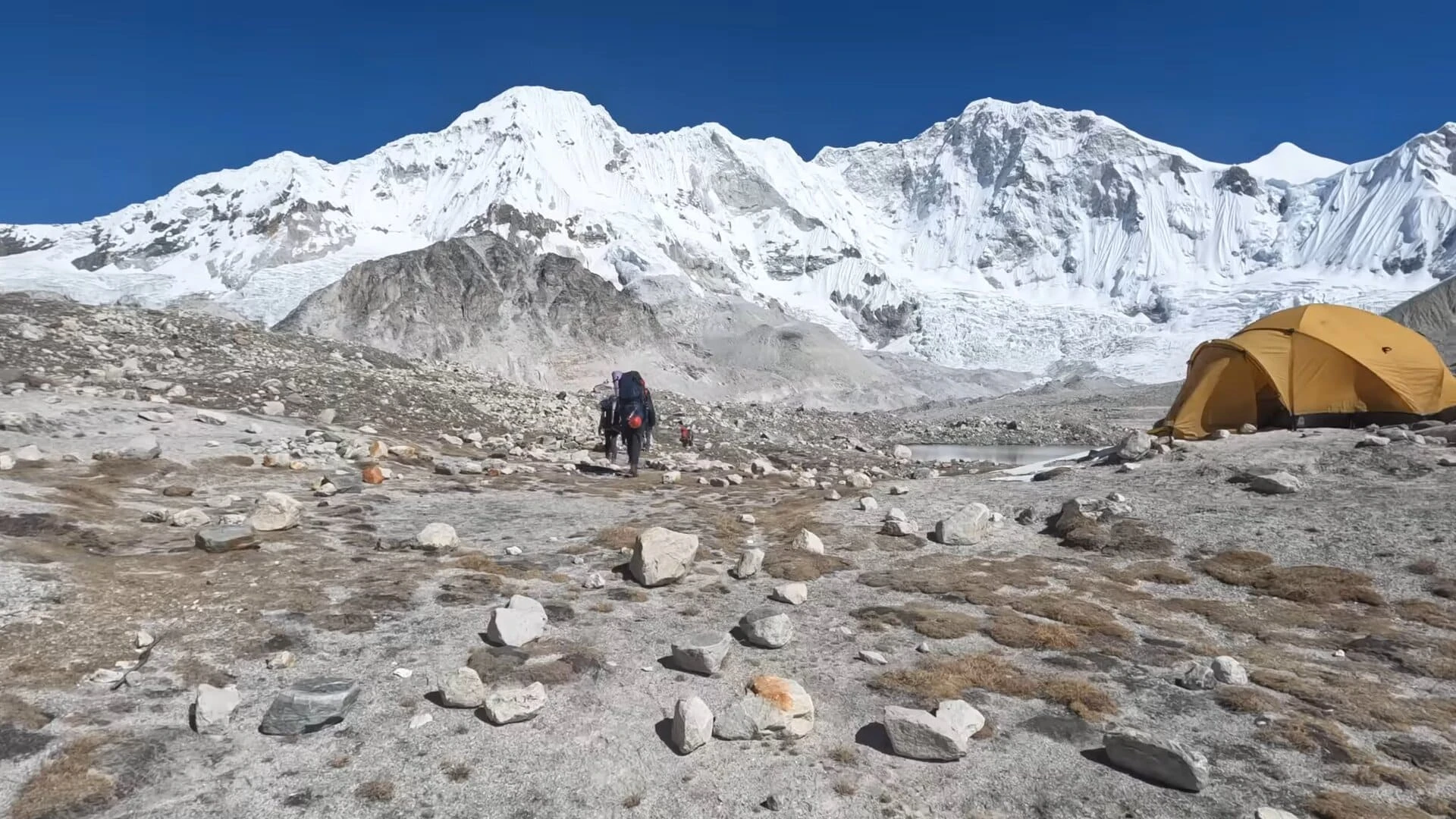
You will walk to the Khamedingma the beautiful alpine basin in the region which is known for its fully remote wilderness before the climbing starts. From this place you will have the proper experience of the ice falls and the glacier valleys. On the way you will cross the rocky moraines and the glacier sections. Our climbing crew will establish the tented accommodations in the Khamedingma.
You will have a climb to the Seto Pokhari which translate as the white pond in the upper mountain regions. The Seto Pokhari is a sacred high-altitude lake and it’s also known for its reflections of the Baruntse peak. The environment here is serene and the peaceful. If you love photography then it’s the perfect place for you.
Today will be the day for the true adventure which will excite you for your climbing journey as you will be trekking to the base of the Baruntse. The distance between the Seto Pokhari to Base camp is around 8 kilo meters which can be reached in the 6 hours. Upon reaching the base camp you will see the tented accommodations ready for you along with the kitchen tent, dinning tent, sleeping tents, and the medical supplies and backups for your safety.
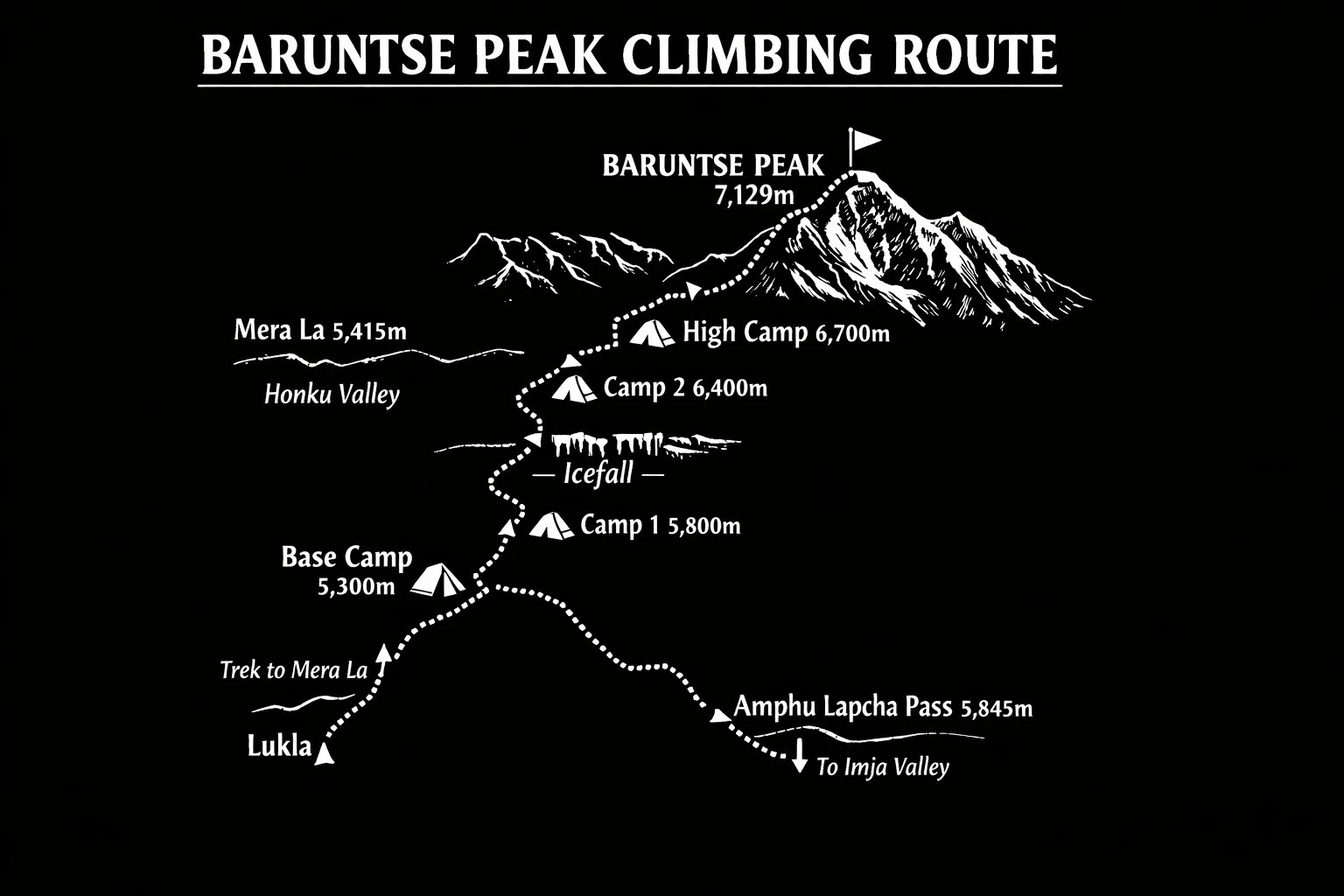
During this phase, we set up Camp I (5,700m) and Camp II (6,400m) while following a gentle climb high, sleep low rotation moving up from Base Camp, touching higher ground, and returning to rest. Along the way, you practice fixed-rope climbing, glacier travel, and crevasse rescue, with strong Sherpa support for load carrying and safety. Plenty of rest and careful weather watching keep the pace flexible, safe, and perfectly timed for the summit push.
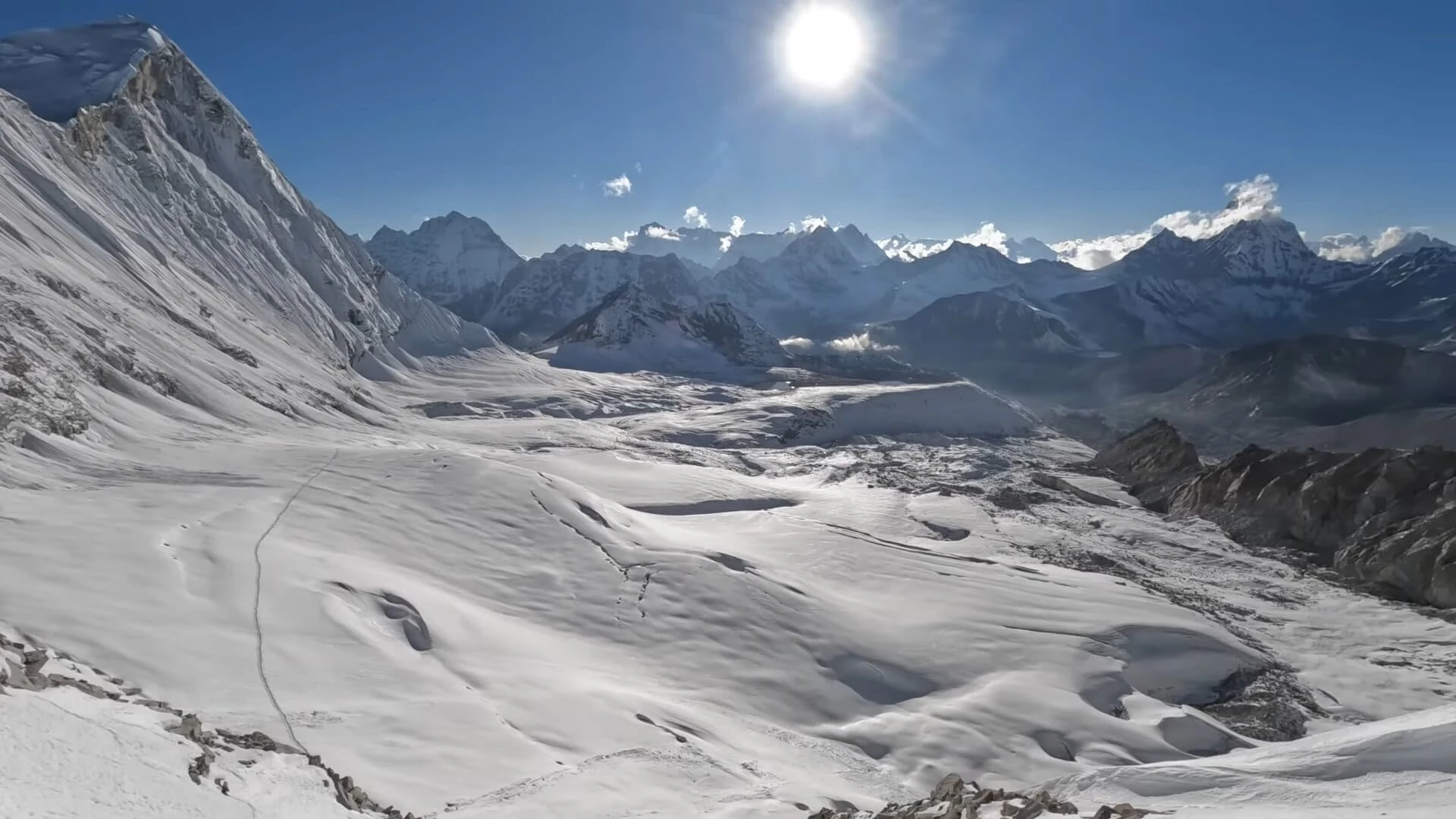
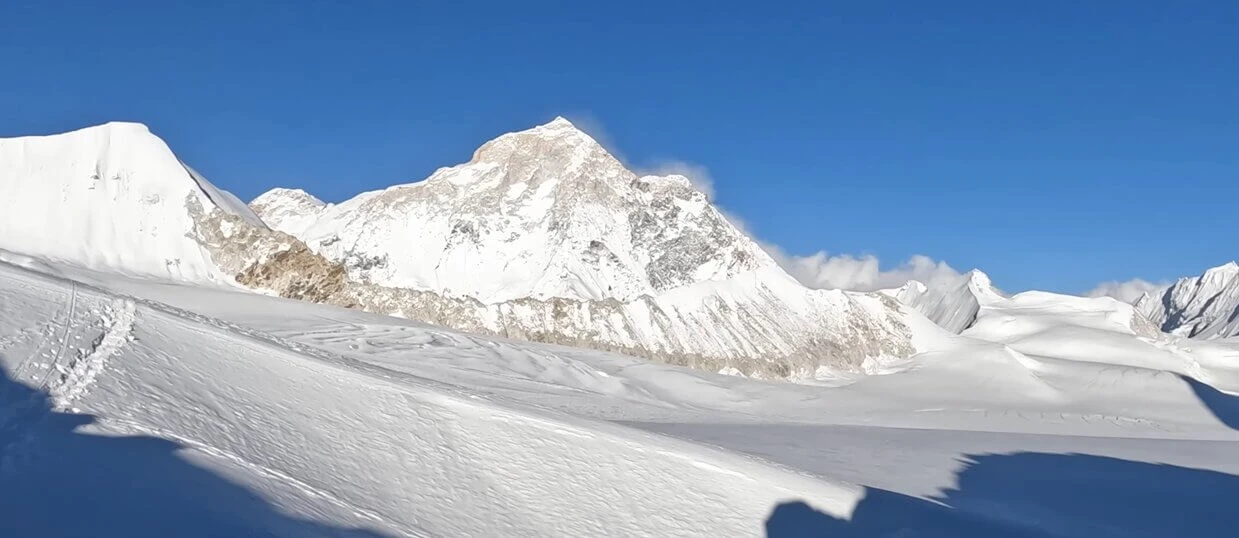
The summit push is the most exciting and rewarding phase of the expedition, carefully spread over several days to maximize safety and success. You will move steadily upward from Base Camp to Camp I, then continue to Camp II, and, if conditions require, establish an optional Camp III higher on the mountain. On summit day, you begin well before midnight, ascending steep 45–55° snow slopes and following fixed ropes along exposed ridges under a sky full of stars. Reaching the 7,129m summit of Baruntse at sunrise is a truly magical moment, with jaw-dropping views of Everest, Lhotse, Makalu, Cho Oyu, and even distant Kanchenjunga. After celebrating this once-in-a-lifetime achievement, climbers descend carefully back through the camps and return safely to Base Camp the following day, carrying unforgettable memories from the top of the Himalayas
After the emotional and physically demanding days on Baruntse, you will leave the base camp and begin your descent toward Kongma Dingma. The trail takes you across glacial moraines, rocky alpine landscapes, and wide open valleys where the dramatic Himalayan scenery still surrounds you. As you descend, you will feel the air becoming slightly richer and the terrain gradually changing from harsh glacier zones to more stable trekking paths. By the time you reach Kongma Dingma, you will finally have a moment to relax and reflect on the incredible achievement of climbing a 7,000-meter Himalayan peak.
Today you will continue trekking through the remote high-altitude landscapes of the Hinku Valley toward Thanknak. The trail passes along glacial rivers and rugged moraine fields while offering incredible views of surrounding peaks and icy ridgelines. As you walk, you will witness the raw beauty of the Himalayas where very few trekkers travel compared to the more crowded trekking regions of Nepal. Reaching Thanknak, you will settle into a quiet mountain lodge and enjoy the peaceful atmosphere of this isolated alpine settlement.
Leaving the glacial valley behind, you will begin the gradual climb toward Thuli Kharka, crossing scenic ridges and alpine meadows along the way. The trail offers spectacular views of the surrounding mountains and deep valleys as you move closer toward the lower Khumbu region. As the altitude decreases, you will notice the return of vegetation and greener landscapes after many days in the high alpine terrain. Arriving at Thuli Kharka, you will enjoy a comfortable evening while preparing for the final trekking days of your expedition.
Your final trekking day will take you from Thuli Kharka down to Lukla, the gateway to the Everest region. The descent passes through beautiful forests, small Sherpa villages, suspension bridges, and lively mountain trails that reconnect you with civilization after weeks in remote wilderness. As you walk through these vibrant mountain communities, you will feel the contrast between expedition life and village life in the Himalayas. Upon reaching Lukla, your team will celebrate the successful completion of both the Baruntse expedition and the incredible journey through the remote valleys of eastern Nepal.
Early in the morning, you will take a scenic mountain flight from Lukla back to Kathmandu. During the short but breathtaking flight, you will witness the spectacular Himalayan ranges stretching across the horizon one last time. Once you land in Kathmandu, you will transfer to your hotel where you can finally enjoy a hot shower, comfortable rest, and a relaxed city atmosphere. The rest of the day is free for you to explore the vibrant streets of Kathmandu or simply celebrate your expedition success.
Today you will visit the Department of Tourism for the official expedition debriefing process. This is an important step for all Himalayan expeditions where climbing details, summit confirmations, and expedition reports are formally submitted. It also gives you the opportunity to reflect on the journey and officially close the expedition with your team and guides. After the formalities, you will have the rest of the day free to explore Kathmandu, visit cultural sites, or shop for souvenirs.
Your incredible Himalayan journey now comes to an end. Depending on your flight schedule, you will be transferred to Tribhuvan International Airport for your international departure. As you leave Nepal, you will carry unforgettable memories of the Baruntse expedition, the remote Barun Valley, and the remarkable experience of climbing above 7,000 meters in the Himalayas. The adventure may end here, but the inspiration to return to the mountains will stay with you forever.
Altitude Graph
You shall do the Baruntse expeditions because it is one of the most beautiful climbing peaks that takes you at an altitude of the 7,129m above sea level along with the one of the most beautiful and less explored places such as the Barun valley and the Hinku Valley.
The best seasons to climb the Baruntse in Nepal is during the month of the autumn which lies in the September to November and the Spring which is from the March to May.
The difficulty level of the Baruntse peak climbing is challenging alpine expeditions. You will need to have the prior climbing and trekking experience to climb summit it.
The Baruntse expeditions can be of 30 to 40 days depending upon the agencies in our case summit 8000 we have organized these expeditions of 32 days.
You will need to have the Cardiovascular fitness (running, hiking, cycling), Strength training for legs and core, Endurance trekking with a backpack (15–20kg) and the technical climbing practice (ice climbing, fixed rope training).
You will need to have the Baruntse climbing permit, Makalu Barun national park permit, and the Hinku valley trek permit to climb the peak.
The main challenges of the Baruntse are that you will face the high altitude climb where the air is very thin, you will need to do the technical climbing, face the unpredictable weather and the each step will test your endurance and the physical strength.
 Nepal
Nepal
 21
21  Sept - Nov & March - May