Destination
Nepal
Duration
35
Destination
Nepal
Duration
35
Trip Difficulty
Challenging
Accommodation
4 Star Hotel, Tea House & Tent
Meals
B, L, & D
Max. Elevation
8163
Group Size
15
Best Time
Sept - Nov
There are mountains that sit on a list, and there are mountains that sit in your chest for years before you finally say yes. Manaslu is the second kind.
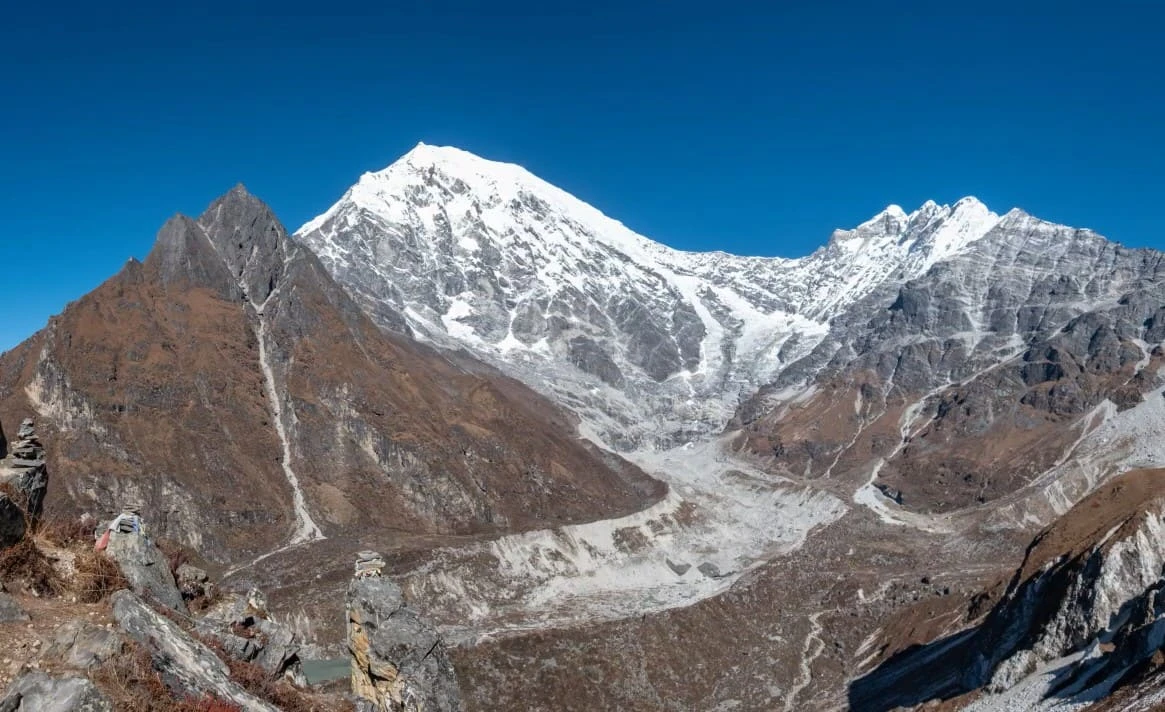
At 8,163 metres, Manaslu is the eighth-highest mountain in the world rising from the remote Mansiri Himal range of west-central Nepal. Its name comes from the Sanskrit word manasa, meaning soul or intellect. Locals have always called it what it truly is the Mountain of the Spirit. Stand at its base on a clear October morning and you will feel exactly why.
Autumn is the best window to climb it. From mid-September through October, the monsoon has cleared, the skies are sharp, and the mountain settles into its most stable, climbable state. Historically, autumn delivers a summit success rate of 75 to 80 percent on Manaslu. The snow firms up. The route fixes cleanly. The weather gives you a fighting chance.
The approach follows the ancient Budi Gandaki valley nine days through Tibetan-influenced villages, past monasteries, prayer flags, and communities that feel genuinely untouched. Places like Samagaun and Lho are not tourist stops. They are living mountain villages, and arriving during the Dashain festival season makes the cultural experience as memorable as the climb itself.
Above base camp at 4,750 metres, the Northeast Face route climbs through four high camps to the death zone and beyond. Summit day begins at 1:00 am. Six to ten hours of climbing with your dedicated Sherpa beside you fixed ropes, supplemental oxygen, exposed ridges, and steep snow until the Himalaya opens up beneath you at 8,163 metres.
Manaslu is demanding. It rewards climbers with real experience at 6,000 to 7,000 metres who are ready to step into the 8,000 m world for the first time. It is where Everest stops being a dream and starts being a plan.
We handle every permit, all logistics, route fixing, meals, oxygen, and a 1:1 Sherpa ratio on summit day. You bring the determination. We handle everything else.
Autumn 2026 bookings are open. If Manaslu has been waiting in the back of your mind this is the season to say yes.
Your expedition begins the moment you land at Tribhuvan International Airport. Our team receives you at the arrivals and transfers you directly to your hotel in Thamel. The rest of the day is yours to rest, settle in, and get your first feel for Kathmandu. In the evening, we sit together for a welcome dinner, you meet your lead guide, your Sherpa team leader, and your fellow climbers, and we walk through what the next 40 days will look like.
An early departure from Kathmandu heading northwest. The drive follows the Budi Gandaki valley road, passing through Arughat before reaching Jagat the gateway to the restricted Manaslu corridor. Your permits are checked at the checkpoint here and the real expedition begins. The road gets rougher and more remote as the city falls away behind you, and by the time you reach Jagat you are already deep in a Nepal that most visitors never see. Overnight in a tea house.
Your first full day on foot through the Budi Gandaki valley. The trail moves through dense forest, across suspension bridges, and along the churning river. The landscape is raw and largely untouched. The Tibetan cultural influence begins to appear in the villages you pass through, with prayer wheels and mani walls lining the trail. A steady, manageable day that eases you into the rhythm of expedition trekking. Overnight in a tea house.
The valley narrows, and the altitude begins to climb more noticeably today. Namrung sits at a higher elevation with wide open views of the surrounding peaks and marks your entry into the true high Himalayan zone. The trail passes through rhododendron and pine forest before opening up into the broader landscape above. The air is noticeably thinner here, and the pace naturally slows, which is exactly as it should be. Overnight in a tea house.
A shorter but meaningful day as the altitude continues to rise. The trail moves through increasingly dramatic terrain fewer trees, more rock, bigger sky. The Tibetan-influenced villages along this section have a timeless quality to them, with ancient monasteries sitting above the trail and the sound of prayer flags in the wind. Your body is working hard at this altitude even on a rest day, so the pace stays deliberate and unhurried. Overnight in a tea house.
One of the great days of the approach. As the trail rounds a ridge above Lho village, Manaslu comes into full view for the first time the entire Northeast Face rising above the valley in a way that stops people mid-step. It is a moment most climbers remember for the rest of their lives. From Lho the path descends into the wide open bowl of Sama Gaun, a Tibetan farming village that will serve as your final rest stop before base camp. Spend the evening slowly eat well, hydrate, and absorb where you are. Overnight in a lodge.
The final approach. The trail climbs steadily from Sama Gaun through increasingly barren and glaciated terrain, following the lateral moraine as the mountain grows larger with every step. Manaslu Base Camp sits at 4,750 metres on a rocky platform above the glacier your home for the weeks of climbing ahead. The afternoon is spent settling into camp and meeting the full team. The traditional Puja ceremony is held at base camp before any climbing begins a blessing from the mountain led by a local lama, and one of the most memorable moments of the entire expedition. Overnight at base camp.
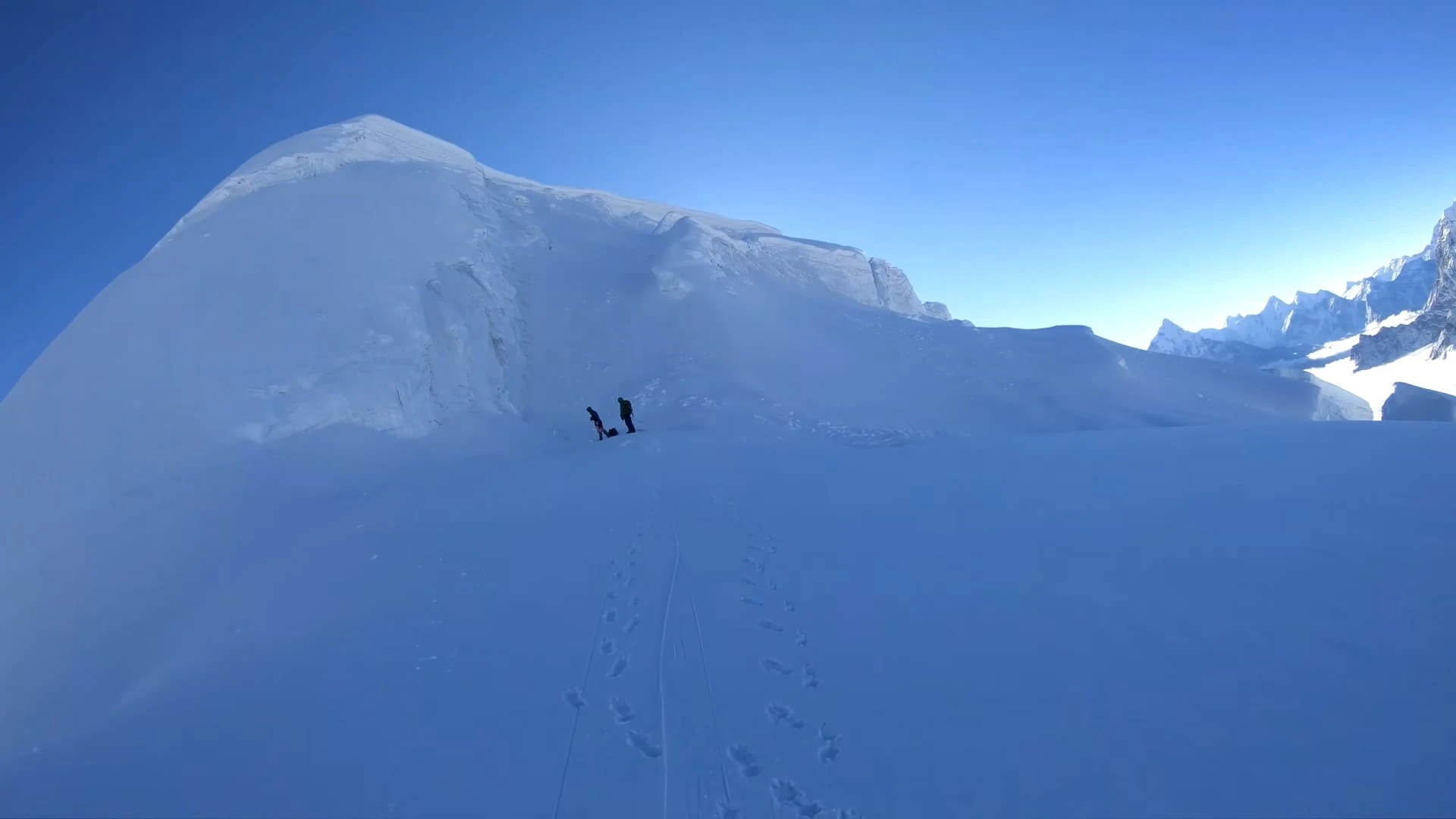
This is the engine of the expedition the phase that determines whether you summit safely or not. Over these fifteen days, we run a structured series of rotation climbs progressively higher on the mountain, allowing your body to adapt to extreme altitude before the final push. The schedule follows a proven high-low-high pattern: climb high, sleep low, repeat. The first rotation takes you to Camp I at 5,700 m and back to base camp the same day your first time on the Manaslu Glacier, navigating crevasse fields on fixed ropes laid by our Sherpa team. The second rotation pushes to Camp II at 6,400 m, the most technically demanding section of the lower mountain, with a night spent above 6,000 metres for the first time. A third rotation may extend to Camp III at 6,800 m, depending on conditions and how your acclimatisation is progressing. Between rotations, you return to base camp to rest and recover. This is where acclimatisation actually consolidates not on the mountain, but in the recovery days below it. Meals are freshly prepared at base camp throughout, and our team monitors every climber's health and progress daily. Rest days are not optional. They are part of the plan. By Day 22 your body has been to altitude, returned to recover, and gone back up again. You are as ready as the mountain will allow you to be.
This is what everything has been building toward. The summit push is a seven-day window that begins with a final departure from base camp and ends if the weather and your body cooperate on the highest point in the Mansiri Himal. You move through the camps methodically: base camp to Camp I, Camp I to Camp II, Camp II to Camp III, Camp III to Camp IV at 7,400 m, your final resting point before the summit. Each move is made with a full kit, supplemental oxygen in use from the upper camps, and your dedicated Sherpa alongside you at every step. The section from Camp III to Camp IV involves the steepest and most physically demanding terrain of the entire climb, a sustained push on a 50 to 55 degree slope that brings you to the edge of the death zone. Summit day itself begins around 1:00 am from high camp. Six to ten hours of focused, deliberate climbing through the dark and then the dawn, up through the exposed ridges and final snow slopes of the Northeast Face. When the mountain gives way beneath you, and you are standing at 8,163 metres, the Himalaya spreads out in every direction: Himalchuli, Ngadi Chuli, the full Annapurna massif, the Tibetan plateau stretching north without end. Your Sherpa is beside you. Take a moment. Then we descend back through the camps and down to base camp, where the team is waiting. The seven-day window exists because the summit does not happen on a fixed schedule. Weather holds, weather breaks, windows open and close. We wait for the right conditions rather than force a timeline. Your safety and your summit chance depend on patience as much as fitness.
The mountain is behind you. The walk back down from base camp to Sama Gaun takes four to five hours and carries with it a particular kind of lightness the pressure of the expedition lifted, the altitude dropping with every step, the warmth of the valley rising to meet you. Sama Gaun feels like a different world after weeks on the glacier. Overnight in a lodge.
Rather than retracing the approach route south through the Budi Gandaki valley, the expedition exits via the Larkya La Pass a high mountain pass at 5,106 m that connects the Manaslu region to the Annapurna Circuit. It is a spectacular finale to the expedition. The crossing takes you through remote high-altitude terrain with sweeping views across the Himalaya before descending steeply to Bhimtang in the lush valley below. Three days of trekking through some of the finest mountain scenery in Nepal a reward that most expeditions ending in a drive back the same way never get to offer. Overnight in tea houses along the route.
From Bhimtang, the trail descends to Dharapani, where the road begins again. A vehicle meets the team here for the drive back to Kathmandu several hours on mountain roads that gradually give way to the valley highway and eventually the familiar chaos of the city. By evening you are back in Thamel, in a proper hotel, with a hot shower, a good meal, and 34 days of the Himalaya sitting quietly behind your eyes. Celebration dinner with the full team tonight. Overnight in Kathmandu hotel.
Your expedition ends. Our team transfers you to Tribhuvan International Airport for your onward flight home. You leave Nepal as a different climber than the one who arrived 40 days ago with an 8,000 metre summit in your legs, in your lungs, and permanently in your story.
Altitude Graph
Everything below is your personal responsibility. Group equipment, high camp tents, cooking gear, and route fixing equipment are provided by our team.
Yes, Manaslu is a good first 8000-meter peak to climb, and it is one of the most popular reasons climbers choose it. Manaslu sits at exactly the right level of challenge for an experienced mountaineer stepping into the 8,000 m range for the first time. It is more demanding than Cho Oyu or Shishapangma but more achievable than Everest or K2. If you have solid experience at 6,000 to 7,000 metres and strong technical skills, Manaslu is the right next step.
The success rate of Manaslu in Autumn is historically the strongest season, with a summit success rate of 75 to 80 percent. October in particular offers the most stable weather window clear skies, manageable temperatures, and firmer snow conditions on the upper slopes compared to spring.
The difficulty level of Manaslu is a serious, technically demanding high-altitude expedition. The route involves glacier travel, crevasse navigation, fixed rope climbing, and sustained effort above 7,000 metres in the death zone. It is not the hardest 8,000 m peak, but it demands respect, proper preparation, and genuine prior experience at altitude. It is not suitable for first-time expedition climbers.
You should have prior climbing experience on peaks between 6,000 and 7,000 metres, ideally peaks like Island Peak, Mera Peak, or something in the 7,000 m range. You need to be technically competent on fixed ropes, crampons, and an ice axe, and physically capable of sustained high-altitude effort across several weeks. If you are unsure whether your experience qualifies, contact us, and we will give you an honest answer.
The best season to climb Manaslu is autumn season specifically mid-September through October is the best time to climb Manaslu. The post-monsoon weather brings stable conditions, clear skies, and excellent visibility. Spring (April to May) is the second season, but autumn consistently delivers better summit success rates and less wind on the upper mountain.
Our Manaslu Expedition Autumn 2026 runs for 35 days from arrival in Kathmandu to departure. This includes the approach trek, the full acclimatisation and rotation phase, the summit push window, the descent, and the exit trek via Larkya La Pass back to Kathmandu. Buffer days are built into the itinerary to account for weather delays these are not padding, they are essential.
You need four permits to climb Manaslu, which are the Nepal government climbing permit, the Restricted Area Permit (RAP), the Manaslu Conservation Area Permit (MCAP), and the Annapurna Conservation Area Permit (ACAP) for the Larkya La exit. All permits are arranged and covered by us as part of your full-service package. You do not need to handle any paperwork yourself.
We wait. Five buffer days are built into the 40-day itinerary specifically to absorb weather delays without affecting your departure date. Our team monitors weather forecasts throughout the expedition and we make summit decisions based on safety first, not schedule. The mountain will be there when the window opens we do not force a push in poor conditions.
Yes, comprehensive travel and expedition insurance with high-altitude mountaineering cover up to 8,163 m is mandatory for every member. It must include emergency helicopter evacuation cover. You arrange this independently before the expedition. We can advise on suitable providers if needed.
 Nepal
Nepal
 18
18  Sept - Nov & March - May